
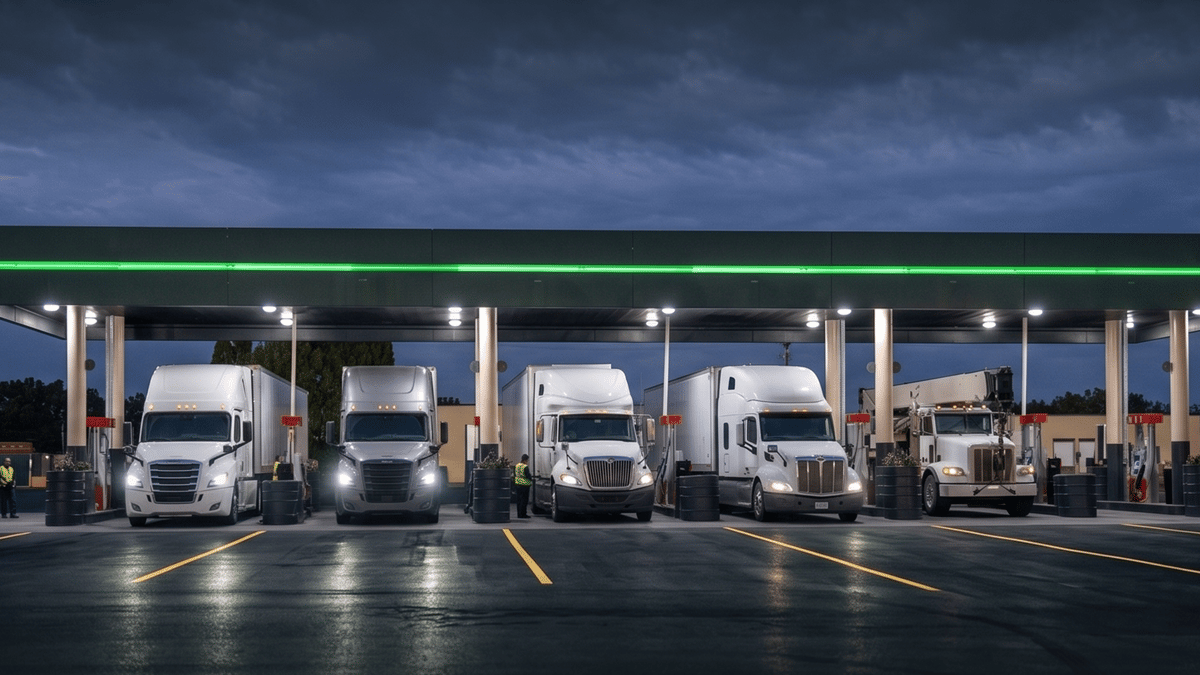
Are your drivers stopping at the right fuel stations? Find out how much your fleet could save on diesel with smarter, data-driven fuel purchasing decisions.
Do you know how much your fleet spends on fuel every week? Most fleet managers know the total. But how many of those dollars could have stayed in your account?
Diesel accounts for roughly 21% of a trucking company's operating costs: it's the second-largest expense, right after driver compensation (ATRI, Operational Costs of Trucking, 2026). And unlike payroll, it's an expense you can act on immediately, every single day. Yet most fleets have no effective strategy for minimizing fuel costs. Drivers stop out of habit, prices aren't checked daily, and potential savings quietly evaporate, one fill-up at a time.
This article breaks down where those losses hide and how to recover them.
Fuel: a massive expense, often poorly managed
Diesel prices fluctuate daily. Not just between regions, but between fuel suppliers, between distribution zones, and sometimes even between two stations a few kilometres apart. For a single truck, a gap of a few cents per litre on every fill-up adds up to roughly $2,500 a year.
The problem? Most carriers have no visibility into these price gaps. Without a tool that compiles and compares prices in real time, every fuelling decision is made blind. Nobody checks supplier price lists before each fill-up. That's normal: doing it manually would be a full-time job.
The result: fuel remains an expense you put up with rather than one you optimize.
Two invisible leaks inflating your diesel bill
The losses don't come from a single source. They build up through two common habits.
-
Drivers choose stations by habit, not by price
It's human nature. A driver who runs the same route every week ends up with favourite stops. But "favourite" doesn't mean "cheapest." Without a recommendation based on that day's prices, every fill-up can cost more than it should.
-
Nobody compiles prices daily
Fuel suppliers publish their price lists every day. Comparing those lists manually to find the best options by zone and by route? It seems unrealistic. So nobody does it. And the money walks out the door.


The modern approach: smart fuel purchasing
Fleet fuel cost optimization means using technology to automatically compile the price lists you've negotiated with your fuel suppliers, compare offers by zone, and recommend the most cost-effective stations along your drivers' routes. Instead of managing diesel purchases blindly, every fuelling decision is based on up-to-date data.
Here's how it works in practice:
- Automatic daily compilation: supplier price lists are retrieved and compared every day, with no manual intervention
- Recommendations by zone and by route: the system identifies the stations to favour based on each driver's planned route
- Confidential price lists: drivers see the gap from the best price, not the prices themselves
- Price history and savings tracking: accumulated price history lets you measure real savings, fill-up after fill-up
That's exactly what Neo Fuel does: it's Neo's fuel optimization solution. On top of price compilation and recommendations, Neo Fuel includes a driver app with an interactive station map, so the right decision is available right on the road.
Results from the first weeks
The advantage of Neo Fuel is that savings show up quickly: deployment takes just a few days, with no process overhaul. As soon as prices are compiled and recommendations are in place, every fill-up becomes an opportunity to save.
Carriers using this type of tool typically see a return on investment within the first weeks after deployment.
A few things that make the difference:
- Driver autonomy: no dispatcher intervention needed. Drivers check recommendations directly on their tablet. In particular, a top 5 of the most cost-effective stations on their route lets them decide quickly.
- Built for fleets of all sizes: per-truck pricing, with unlimited users.
- No infrastructure to install: cloud-based solution, accessible from anywhere, ready from day one.
Customer support and updates are included: there are no hidden fees.
Fuel is an unavoidable expense, but one you can minimize.
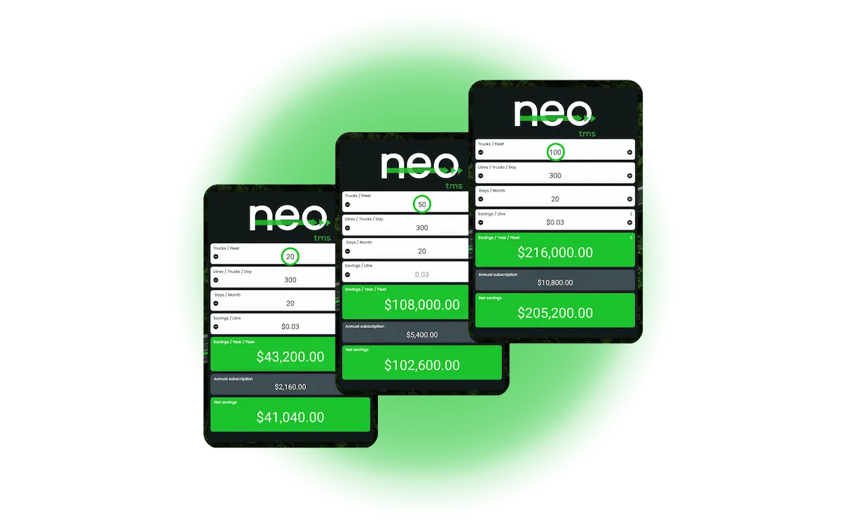
Estimate your savings
Every day without visibility into diesel prices, you're letting savings slip away that add up to thousands of dollars by year-end. The amount is probably bigger than you think!
→ Estimate your savings with the Neo Fuel calculator
Frequently asked questions
Do I need to switch fuel suppliers to save?
No. Optimization means making better use of the offers already available on the market. You keep your current agreements, but you identify when and where prices are most favourable.
Does fuel optimization work for small fleets?
Yes. Savings scale with fleet size, but even a 15-truck fleet can see significant gains. With per-truck pricing, Neo Fuel is designed to be accessible even for small fleets.
How do drivers get the recommendations?
Through a mobile app with an interactive map. Drivers see recommended stations directly along their route, with no unnecessary detours.
Do dispatchers have access to the tool?
Yes. Dispatchers access the same recommendations and price history directly in Neo TMS. They can view the suggested stations for each route, but the tool is designed so drivers make the decision themselves, without the dispatcher having to step in day to day.
You might also like